Skip to content
Atomic Software Studio

Software studio
Medellín, Colombia

We build the systems that do the work.

AI systems, automation, integrations, and the software around them. We take them all the way into production — where they run unattended, and leave a trace when something breaks.

appointment pipeline · representative runcompleted
A representative execution trace of the appointment automation pipeline, listing each node in the order it runs.
nodestatus
whatsapp.triggerok
audio.downloadok
transcribe · whisperok
normalizeok
fields_mappingok
agent.planok
tool · check_availabilityok
tool · get_bookingok
whatsapp.replyok

node names and order read from the live workflow

01

Capabilities

Four things, and the lines between them are thin.

Most projects touch at least three. An agent is only useful once it can reach a real calendar; an integration is only finished once someone can see what it did. We scope the work by the outcome, not by the category it belongs to.

  • AI systems & agents

    Agents that use tools, hold context, and act on systems that matter — not a chat window bolted onto a FAQ. We decide what the model is allowed to do, what it has to ask about, and what happens on the days it gets something wrong.

    • OpenAI
    • Whisper
    • tool calling
    • memory
  • Automation & workflow engineering

    The connective work between systems that were never designed to talk to each other. Triggers, retries, and the unglamorous error handling that decides whether an automation survives contact with real traffic.

    • n8n
    • webhooks
    • schedulers
    • error handling
  • Web & product engineering

    Applications, dashboards, and the interfaces around a system — the place people go when they need to see what the automation actually did.

    • Next.js
    • TypeScript
    • React
    • Tailwind
  • Integrations, cloud & operations

    APIs, deployment, isolation, monitoring. Going live is a milestone, not the finish line — most of the value shows up in the months afterwards.

    • WhatsApp Cloud API
    • Meta Apps
    • Google Cloud
    • Docker
02

Selected work

Two systems, both running.

Not concepts. Both of these are deployed, and both handle traffic we did not schedule.

Appointment automation

01 / 02

A booking system that starts with a voice note.

Someone sends a WhatsApp message — often audio, often at an hour when nobody is at a desk. The system transcribes it, works out what was actually being asked, checks the calendar, books the slot, and replies. No form, no callback, no queue.
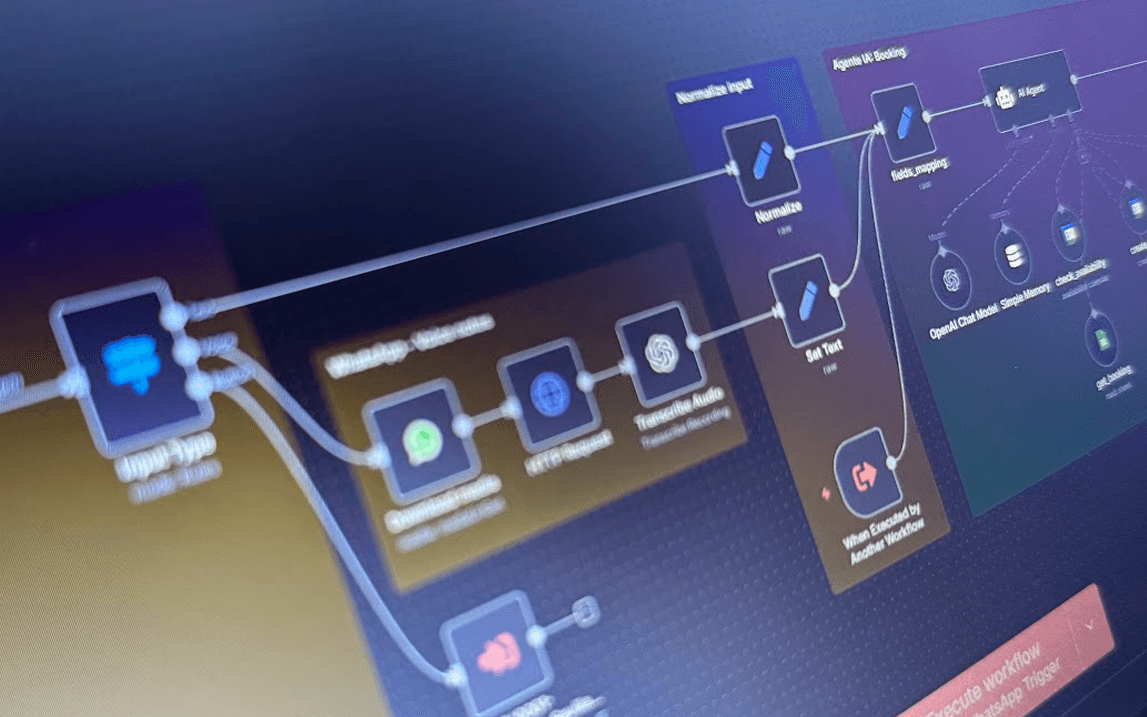
The appointment pipeline open on an n8n canvas: a WhatsApp trigger feeding audio download, an OpenAI transcription node, a normalize step, and an AI agent wired to calendar tools.
The pipeline on its n8n canvas
Stack
  • n8n
  • OpenAI
  • WhatsApp Cloud API
  • Google Cloud
Outcome
Booking runs end to end with nobody in the loop, including outside working hours and when the request arrives as audio.

Read the case study

Multi-client automation platform

02 / 02

One environment, many clients, no shared blast radius.

Each client’s workflows, credentials and data sit behind their own walls, so a change made for one can never reach another. Onboarding a client is a provisioning step rather than a rebuild, which is the difference between running a platform and maintaining a pile of one-offs.

Stack
  • n8n
  • Docker
  • Meta Apps
  • WhatsApp Cloud API
Outcome
A change or a failure in one client environment has no path into another, and onboarding a new client is a provisioning step rather than a rebuild.
Read the case study
03

How we work

Four opinions we are not flexible about.

These are not preferences. Each one is a decision that has already been made in the systems above, and each one costs something up front to hold.

  • Production is the deliverable

    A workflow running on somebody’s laptop is a prototype. We hand over systems that are deployed, credentialed and monitored — and until that is true, the work is not finished.

  • Meet the systems already in place

    Most automation dies at the integration boundary, not at the idea. We build into the tools a business already runs on rather than asking a team to migrate to something new to make our job easier.

  • Isolation by default

    Every client gets their own environment. Your credentials, your data, your failure domain. A problem in one place should not be able to travel to another, and that has to be designed in rather than promised.

  • Everything leaves a trace

    Things break. The only question that matters is how quickly you can see why. Runs are logged, failures are visible, and the path through the system stays legible after the fact.

04

Stack & clients

What we actually run.

Not a certification wall. This is what is in production right now — if something is not on this list, we will say so rather than learn it on your budget.

Automation

  • n8n
  • Webhooks
  • Scheduled triggers
  • Error handling

AI

  • OpenAI
  • Whisper
  • Tool calling
  • Conversation memory

Web

  • Next.js
  • React
  • TypeScript
  • Tailwind

Infrastructure

  • Docker
  • Google Cloud
  • Meta Apps
  • WhatsApp Cloud API

Working with

  • Grupo NexIA
05

Contact

Start with the problem, not the brief.

Tell us what the system needs to do and what currently happens instead. If we are the right studio for it we will say so, and if we are not we will usually know who is.

Email

Tell us what the system needs to do. We reply to everything.

contact@atomicstudio.dev

Atomic is led by Daniel Ramirez in Medellín, Colombia. More about Daniel Ramirez.